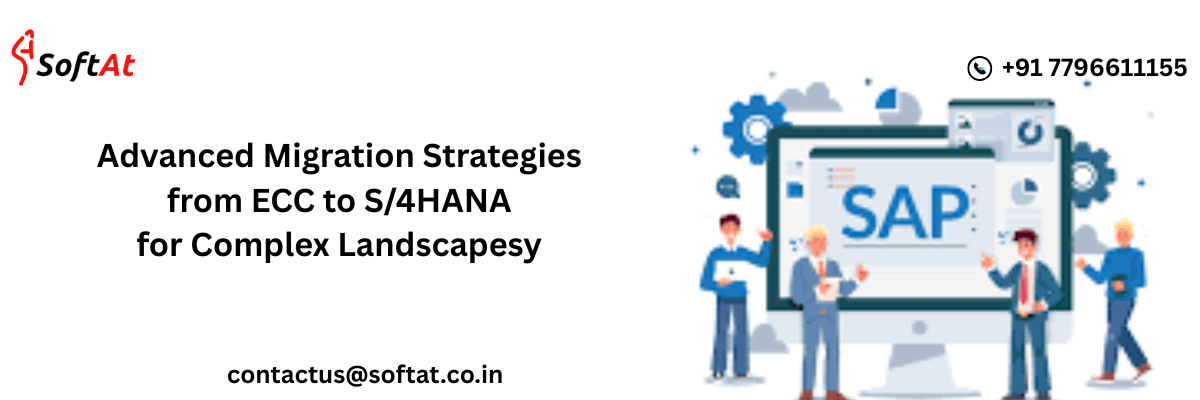
- The world of enterprise resource planning (ERP) is evolving rapidly, and businesses can no longer afford to stay behind. SAP’s push towards S/4HANA has made it clear: organizations running on SAP ECC (ERP Central Component) must prepare for migration if they want to remain competitive.
But what does migration really mean for companies with complex IT landscapes? And how can beginners—whether business leaders or employees—understand and navigate these advanced strategies without feeling overwhelmed? Let’s break it down in a clear, conversational way.
Why S/4HANA Migration Matters
SAP has announced the end of mainstream maintenance for ECC by 2027 (with optional extended support until 2030). This deadline is driving organizations to plan their journey toward S/4HANA.
Unlike ECC, S/4HANA isn’t just an upgrade—it’s a digital transformation platform. With its in-memory database, real-time analytics, and streamlined processes, businesses can unlock faster decision-making, simplified operations, and future-ready scalability.
For companies with multi-system integrations, custom developments, or global operations, migration is not as simple as “lift and shift.” Instead, it requires advanced strategies to minimize disruption and maximize value.
Migration Approaches: A Quick Refresher
Before diving into advanced strategies, let’s understand the three main migration approaches:
- Greenfield (New Implementation):
A fresh start. Companies build an entirely new S/4HANA environment and migrate only necessary data.
Best for: Organizations looking to re-engineer processes from scratch. - Brownfield (System Conversion):
Directly converts the existing ECC system into S/4HANA.
Best for: Businesses that want to keep most of their processes and customizations. - Selective Data Transition (Hybrid):
A flexible mix. It allows selective migration of data, processes, and configurations.
Best for: Complex landscapes where companies want to preserve what works while modernizing the rest.
Advanced Migration Strategies for Complex Landscapes
When dealing with large enterprises, mergers, or multi-country operations, advanced strategies are key to a successful migration. Here are the most critical ones:
1. Landscape Transformation
For organizations managing multiple ECC systems across different geographies or business units, landscape transformation consolidates them into a unified S/4HANA system. This reduces complexity, lowers costs, and ensures consistent processes.
Relatable Example: Imagine a global retail company running five separate ECC systems in different regions. With transformation, they unify everything into one powerful S/4HANA system—streamlining supply chain, sales, and financial reporting.
2. Phased vs. Big-Bang Migration
- Phased Migration: Breaks the journey into smaller, manageable steps. For example, starting with finance, then logistics, then customer experience.
- Big-Bang Migration: Migrates all systems at once into S/4HANA.
Tip: For highly integrated and critical systems, phased migration often reduces risk while allowing employees to adapt gradually.
3. Cloud-First Strategy
Many businesses combine migration with cloud adoption. Running S/4HANA on hyperscalers like AWS, Azure, or Google Cloud enables scalability, cost flexibility, and future-ready innovation.
Industry Insight: According to market reports, more than 60% of companies migrating to S/4HANA are adopting cloud-hosted or hybrid environments to future-proof their IT strategy.
4. Data Harmonization and Cleansing
Complex landscapes often contain decades of redundant or inconsistent data. Advanced strategies focus on data harmonization—standardizing master data across systems—before migration.
Real-World Application: A manufacturing company migrating thousands of product records ensures consistent naming conventions and eliminates duplicates, making reporting and analytics more accurate in S/4HANA.
5. Custom Code and Extension Management
ECC landscapes usually carry years of custom code. Advanced migrations use tools like SAP Readiness Check to identify which custom developments are still relevant and which should be retired or rebuilt using modern side-by-side extensibility.
Motivational Note: Think of this as decluttering your house—migration gives you a chance to let go of outdated customizations and embrace cleaner, standardized processes.
Key Market Trends Shaping Migration
- Acceleration of Digital Transformation: Businesses want real-time insights and faster processes to stay ahead of competitors.
- Rise of Automation: Robotic process automation (RPA) and AI are increasingly integrated into migration projects, reducing manual effort.
- Industry-Specific Solutions: SAP offers industry-tailored S/4HANA capabilities (for retail, manufacturing, finance, etc.), making migration more attractive.
- Demand for Skilled Professionals: Companies are investing in upskilling employees to understand S/4HANA concepts, ensuring smoother adoption.
Practical Tips for Beginners
- Start with Education: Learn the basics of S/4HANA and migration strategies before diving into technical details.
- Run a System Assessment: Use SAP tools to analyze your current ECC landscape and identify complexity hotspots.
- Engage Stakeholders Early: Migration isn’t just an IT project—it impacts finance, HR, supply chain, and more.
- Pilot First: Test migration on a smaller scope (like a regional office) before rolling it out globally.
- Invest in Training: Equip employees with knowledge to adapt to the new environment confidently.
Final Thoughts
Migrating from ECC to S/4HANA is not just a technology project—it’s a business transformation journey. For companies with complex landscapes, advanced strategies like landscape transformation, phased approaches, cloud-first adoption, and data harmonization are the keys to success.
If you’re just beginning, don’t feel overwhelmed. Every great journey starts with a single step—and that step is learning.
👉 Ready to explore in-depth strategies and hands-on training? Check out our advanced S/4HANA migration courses and resources on our website to guide you through every stage of the transformation.
you may be interested in this blog here:-
Don’t Fear the Update: Navigating the Challenges of how to implement sap note
Five Top Technology Investment Drivers for 2024
How many dollars worth of RSU does Salesforce typically offer an MTS (experienced hire) on joining?
Integration cloud system to HANA Cloud Platform using Cloud Connector