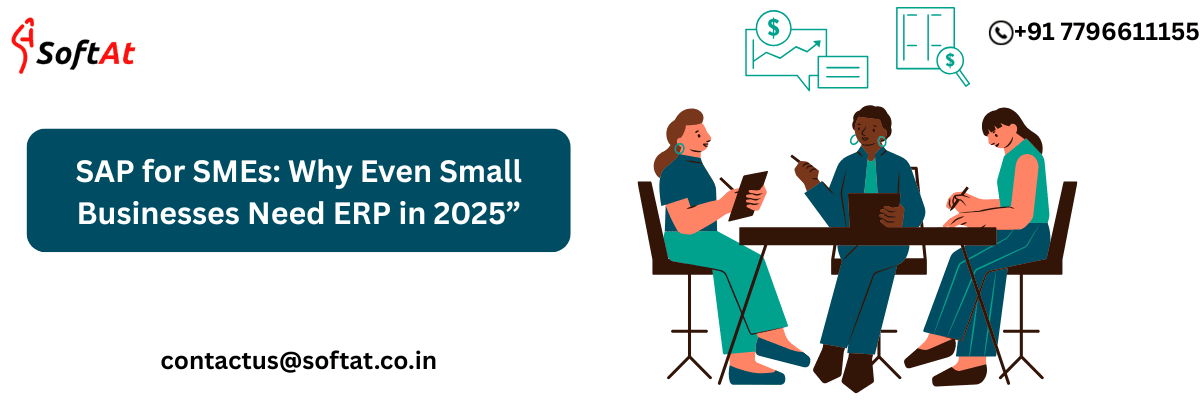
In 2025, small and medium-sized enterprises (SMEs) face an exciting yet challenging business environment. Markets are faster, customer expectations are higher, and data drives nearly every decision. Yet, many small business owners still rely on spreadsheets, disconnected systems, or outdated software to manage operations. The truth is, in today’s digital world, these tools simply can’t keep up. That’s why SAP for SMEs—an enterprise-level ERP solution designed for growing businesses—is becoming a game changer.
The misconception that ERP systems are “too complex or expensive” for small businesses is quickly fading. Modern ERP solutions like SAP are now more affordable, scalable, and user-friendly than ever. For many SMEs, adopting SAP isn’t just a technology upgrade—it’s a survival strategy and a competitive advantage rolled into one.
Why small businesses can no longer ignore digital transformation
For decades, enterprise software was seen as something only large corporations could afford. But the business landscape has changed dramatically. Automation, cloud computing, and data analytics have leveled the playing field. Small businesses now have access to the same technology that powers multinational corporations—but customized to fit their scale and budget.
In 2025, digital transformation is not optional. It’s a requirement for staying relevant. Customers expect fast responses, personalized service, and reliable delivery. Supply chains must be agile, and financial transparency is non-negotiable. SAP for SMEs helps small businesses manage all of this seamlessly, integrating finance, sales, inventory, HR, and customer management in a single, intelligent system.
Consider a local manufacturing company that used to track orders on paper and manage invoices in Excel. As demand grew, errors multiplied—wrong deliveries, late payments, and inventory shortages became common. After implementing SAP for SMEs, every process—from procurement to shipping—became connected and automated. Decisions that once took days could now be made in real time, supported by accurate data.
What SAP for SMEs really means
SAP for SMEs isn’t a “lite” version of what big companies use. It’s a suite of intelligent ERP solutions designed specifically for small and midsize businesses. It combines business process automation with deep analytics, making it easier to manage growth and complexity without adding more manual work.
At its core, an ERP (Enterprise Resource Planning) system is software that brings every business function together. Instead of running finance, HR, production, and sales separately, SAP integrates them into one system. This creates a single source of truth, eliminating redundant data entry, improving communication between departments, and ensuring that everyone works from the same up-to-date information.
The key benefits of SAP for SMEs in 2025
Small businesses implementing SAP are seeing tangible results—both operational and strategic. Let’s explore some of the biggest advantages:
- End-to-end visibility: With SAP for SMEs, business owners get a 360-degree view of their operations. Whether it’s tracking sales performance, monitoring cash flow, or managing supplier relationships, all data is centralized and accessible in real time.
- Informed decision-making: Instead of relying on gut instinct, SMEs can base decisions on accurate analytics and reporting. SAP’s dashboards turn raw data into meaningful insights, helping leaders identify trends, control costs, and plan ahead.
- Automation that saves time and money: Tasks like invoicing, payroll, and inventory updates can be automated, freeing teams from repetitive work and reducing human error.
- Scalability and flexibility: Unlike traditional software, SAP solutions grow with your business. Whether you’re opening a new branch or expanding into e-commerce, the system adapts without disruption.
- Regulatory compliance and security: SAP ERP helps small businesses meet tax and data protection regulations, reducing risk and ensuring financial accuracy.
- Customer-centric operations: With better integration between sales, service, and logistics, businesses can deliver faster responses and more personalized experiences.
How SAP supports growth at every stage
What makes SAP for SMEs especially valuable is its ability to grow with you. Many small businesses start with limited resources but ambitious goals. SAP enables them to start small—perhaps with finance and inventory modules—and then expand as their needs evolve.
For instance, a family-run retail store can begin by automating inventory and billing. As it scales into multiple outlets, SAP can incorporate warehouse management, CRM, and marketing automation. The same applies to a service-based startup that begins by tracking projects and later integrates payroll, analytics, and budgeting. The modular design means you only pay for what you use, ensuring efficiency at every growth stage.
Real-world examples of transformation
Across industries, small and medium businesses are proving that digital transformation isn’t reserved for tech giants. A small textile manufacturer, for example, used SAP to synchronize its production schedule with supplier deliveries, cutting lead times by 20%. A local distributor used SAP’s reporting tools to spot seasonal buying trends and doubled sales through smarter inventory planning. Even small service-based firms are using SAP for SMEs to automate billing and project tracking, improving client satisfaction and cash flow simultaneously.
These stories demonstrate that technology is no longer a luxury—it’s a necessity that gives small players the speed and precision to compete with larger rivals.
Trends shaping ERP adoption among SMEs
The future of ERP for small businesses is being shaped by several major trends:
- Cloud ERP dominance: More SMEs are moving to cloud-based systems for flexibility and lower upfront costs. This eliminates the need for heavy IT infrastructure and allows remote access anytime, anywhere.
- Artificial Intelligence and analytics: Predictive tools within SAP for SMEs help forecast demand, optimize pricing, and detect potential issues before they occur.
- Mobile ERP applications: Business owners can now manage inventory, approve invoices, or track sales from their phones, improving mobility and responsiveness.
- Sustainability integration: SMEs are using ERP systems to monitor resource usage and reduce waste, aligning with global sustainability goals.
- Subscription-based pricing: ERP is becoming more accessible through flexible payment models, removing the barrier of large one-time investments.
These developments mean that by 2025, even the smallest businesses can harness the power of enterprise-grade tools to run leaner, smarter, and more competitively.
Common misconceptions holding SMEs back
Despite its benefits, many small business owners hesitate to implement ERP solutions due to lingering myths. Let’s debunk a few:
- “It’s too expensive.” Modern SAP for SMEs offers cloud options with affordable monthly plans, making enterprise technology accessible even to startups.
- “It’s too complicated.” The interfaces are intuitive, with training modules and support designed for non-technical users.
- “We’re too small to need it.” ERP isn’t just for growth—it enables growth. Even a business with five employees can benefit from process automation and data accuracy.
- “Implementation takes forever.” With cloud-based systems, setup can be completed in weeks, not months.
Recognizing these myths as outdated perceptions allows SMEs to embrace tools that can truly transform their operations.
Building a roadmap for ERP adoption
If you’re new to ERP systems, the journey begins with clarity and strategy. Here’s a simplified roadmap for adopting SAP for SMEs successfully:
- Assess your current challenges. Identify pain points like inventory errors, delayed reporting, or communication gaps.
- Set clear objectives. Define what success looks like—faster invoicing, better forecasting, or improved collaboration.
- Start small. Begin with essential modules such as finance or sales and expand as your team gains confidence.
- Train your people. ERP success depends on adoption. Invest in employee training and encourage open communication during the transition.
- Monitor and refine. Use real-time dashboards to track progress and make continuous improvements.
By following these steps, SMEs can transition smoothly into a fully integrated business model powered by SAP.
The mindset shift that drives success
Digital transformation is not just about adopting new tools—it’s about rethinking how your business operates. The most successful SMEs treat SAP not as software, but as a growth partner. They use it to innovate, anticipate market changes, and build stronger customer relationships.
In 2025, agility is the ultimate competitive edge. SAP for SMEs gives small businesses the agility to adapt quickly, the insight to make better decisions, and the structure to scale confidently.
The road ahead: turning potential into performance
Every small business today stands at a crossroads. One path leads to growth driven by data, automation, and strategic insight. The other risks stagnation and inefficiency. The difference often comes down to whether leaders are willing to embrace the right technology.
With SAP for SMEs, small businesses are no longer limited by size or resources. They can operate with the same intelligence, precision, and agility as large enterprises—without the complexity.
If you’re ready to future-proof your business, now is the time to act. Explore our expert guides, tutorials, and online courses to understand how SAP for SMEs can revolutionize your operations in 2025 and beyond.
Take the first step today—embrace SAP for SMEs and unlock the power of ERP to grow smarter, faster, and stronger.
YOU MAY BE INTERESTED IN
ABAP Evolution: From Monolithic Masterpieces to Agile Architects