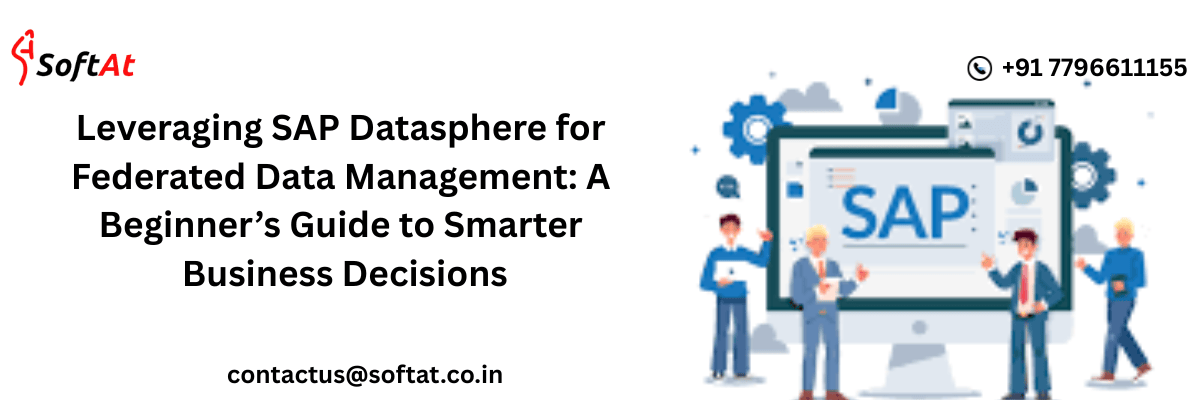
In today’s digital-first economy, data is often called the new oil. But if you’re like many beginners stepping into the world of enterprise technology, you may wonder—what does that actually mean for me or my organization? Here’s the truth: businesses no longer just generate data; they thrive on it. And managing this growing ocean of information has become one of the biggest challenges for enterprises worldwide. That’s where SAP Datasphere for Federated Data Management comes in—a solution designed to simplify, connect, and empower data-driven decisions.
This blog is your easy-to-digest roadmap to understanding the fundamentals of SAP Datasphere, why federated data management is a game-changer, and how you can start using it to build smarter strategies for both business growth and financial success.
What Is SAP Datasphere?
At its core, SAP Datasphere is a cloud-based data management service that helps businesses unlock the full potential of their data—no matter where it lives. Think of it as a bridge that connects scattered information from multiple sources—whether it’s SAP applications, third-party systems, or even spreadsheets—into one unified, trusted layer of data.
Instead of moving data from one place to another (which can be expensive and risky), SAP Datasphere allows you to access and work with data where it already resides. That’s the beauty of federated data management.
Understanding Federated Data Management
Imagine your business data as books in different libraries. Traditionally, to read them, you’d have to carry all those books into one central library. With federated data management, however, you can simply visit each library virtually and still get the information you need—without moving the books.
This approach ensures:
- Speed: No delays caused by moving data around.
- Accuracy: Data remains consistent at the source.
- Security: Sensitive information stays protected where it is stored.
For businesses, this means faster insights, fewer risks, and smarter decision-making.
Why Is Federated Data Management Important Today?
The demand for reliable, real-time insights has skyrocketed. According to industry reports, organizations generate 2.5 quintillion bytes of data daily, much of which is stored in disconnected systems. Without integration, valuable insights are left untapped.
Federated data management solves this challenge by providing:
- Seamless integration across platforms
- Lower IT costs by avoiding redundant storage
- A single version of truth for decision-makers
This trend is especially relevant for companies navigating hybrid or multi-cloud environments. The ability to unify data without replication positions businesses for competitive advantage in fast-changing markets.
Real-World Applications of SAP Datasphere
So, how does this look in practice? Let’s break down a few relatable examples:
- Retail Industry
A retail chain collects customer data through its e-commerce site, point-of-sale systems, and loyalty apps. Using SAP Datasphere, managers can see a unified customer profile in real time—enabling personalized offers and boosting sales. - Financial Services
Banks often rely on multiple systems for customer accounts, loans, and compliance. Federated access allows analysts to build holistic risk reports without duplicating sensitive financial data. - Manufacturing
Manufacturers depend on supply chain data across global partners. SAP Datasphere enables them to monitor operations without moving data from suppliers’ systems—ensuring timely decisions and cost savings.
Key Benefits for Beginners and Businesses Alike
For those new to data management, here are the standout benefits of adopting SAP Datasphere:
- Scalability: Grow your data landscape without limits.
- Flexibility: Connect SAP and non-SAP data effortlessly.
- Transparency: Gain confidence in decisions backed by real-time insights.
- Collaboration: Enable cross-department teams to access the same trusted data.
Practical Tips for Getting Started
If you’re ready to dip your toes into SAP Datasphere and federated data management, here are simple steps to begin:
- Identify key data sources in your organization.
- Start small with a use case, such as customer data integration.
- Collaborate with IT and business teams to ensure adoption.
- Leverage SAP training resources to build in-house expertise.
- Monitor progress and expand once the first project shows results.
Remember, success with data management doesn’t happen overnight. Start with a focused use case and scale gradually.
Industry Insights and Market Trends
Analysts predict that by 2026, nearly 65% of enterprises will adopt federated data management strategies as part of their digital transformation journeys. This growing adoption is driven by:
- The rise of hybrid cloud solutions
- Increased need for data privacy and governance
- The demand for real-time, AI-driven insights
In short, federated data management isn’t just a buzzword—it’s becoming an industry standard.
From Data Management to Financial Literacy
You might ask: how does this connect to financial literacy? Well, strong data management is like personal financial planning. Just as you wouldn’t put all your money in one account without tracking where it’s going, businesses can’t afford to silo their data. By building a unified, transparent view of assets (whether money or data), both individuals and companies make smarter decisions for long-term success.
Your Next Step Toward Success
Leveraging SAP Datasphere for federated data management isn’t just about technology—it’s about empowering smarter strategies, reducing costs, and unlocking future opportunities. Whether you’re a curious beginner or an employee eager to grow your skills, now is the perfect time to start your journey.
Take the first step today by exploring our advanced SAP learning resources and courses designed to help you master data management and become a future-ready professional.
Read more in the blogs:
How to Create Variant in SAP
Demystifying the CRON Expression in Salesforce: Unveiling the Power of Scheduled Jobs